
Products compared
Anker
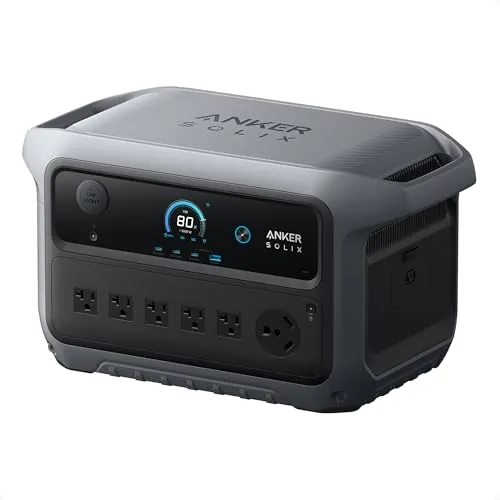
Anker SOLIX C2000 Gen 2 Portable Power Station
U.S. base-unit listing for manufacturer model A1783. Check the retailer’s current offer for availability and package contents.
Model A1783
Amazon ASIN B0FVFGL38H
EcoFlow
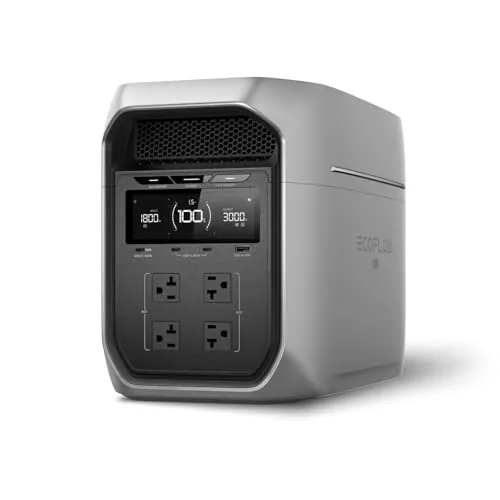
EcoFlow DELTA 3 Max Plus (2048Wh) Portable Power Station
U.S. DELTA 3 Max Plus base-unit listing, not the DELTA 3 Max. Check the retailer’s current offer for availability and package contents.
Model EF-DL3-MP
Amazon ASIN B0FQV9Q9J2
Differences that matter
What matters most to you?
Choose a priority to see what it changes.
Sources for Standard AC output versus peak/boost labels
Sources for Solar/PV input ceiling
Sources for Vehicle charging routes
Sources for Listed body dimensions and weight
Start with the ordinary AC rating and connector
The C2000 Gen 2 lists NEMA 5-20R and TT-30R outlets, but Anker rates the TT-30R at 120V/20A max and states 2,400W continuous AC output overall. That makes the outlet a connector option, not a 30A continuous source. EcoFlow lists four 20A-max AC outlets with a 3,000W shared total. For either station, compare the appliance label and startup needs to the total rating; the number printed for one outlet is not available from every other outlet at once.
Keep secondary headline figures separate: Anker lists 4,000W peak; EcoFlow lists 6,000W surge and separately describes X-Boost support up to 3,800W. Those are not a like-for-like continuous output comparison or a test that a particular appliance will start. If your plan depends on one, check the maker’s exact conditions for that load.
Check AC, solar, and vehicle charging against the source you have
Both makers list up to 1,800W AC charging input. Their published PV ceilings differ: Anker lists 800W through its XT60i input, while EcoFlow lists 1,000W maximum PV input. Anker’s page also advertises 2,600W AC-plus-solar input. Treat these as input ratings, not measured time-to-charge results.
Before choosing a solar array, compare its open-circuit voltage and short-circuit current in the intended string arrangement with the exact model manual and cable. EcoFlow’s US manual describes two XT60i inputs and specifies model solar voltage/current limits; Anker’s A1783 material lists 11–60V and 17A maximum. Do not infer compatibility from panel watts alone.
Vehicle charging is a separate check. Anker lists a 100W car input and an 800W alternator-charger route; its base-unit contents list only the station, 15A AC cable, and manual. EcoFlow’s manual describes car input through the DC/solar input and a separately sold car cable, while its product documentation names add-on alternator chargers. Check the exact source, accessory model, and supported input profile rather than assuming those faster routes are part of either base kit.
Count the expansion parts before planning a larger capacity
Anker names one BP2000 (Gen 2) expansion battery, rated at 2,048Wh, for its stated 4kWh setup. EcoFlow’s exact expansion-battery page describes adding up to two 2,048Wh DELTA 3 Max Plus Smart Extra Batteries for a 6,144Wh total; EcoFlow says the two-battery connection requires its Extra Battery Expansion Adapter.
These are accessory configurations, not what is assumed to be in the base-unit offer. Match battery model names and station compatibility, then account for the adapter, extra units, room to place them, and a separate budget. EcoFlow advertises a broader scalable range; this comparison sticks to the specifically documented 6,144Wh configuration and does not assess every expansion combination.
Measure storage separately from your electrical plan
Anker publishes an 18.1 × 9.8 × 10.1-inch body and 18.9 kg weight; EcoFlow lists 494 × 242 × 305 mm (height × width × depth) and 22.1 ± 0.4 kg. Convert the dimensions to the orientation you plan to store, and leave room for the exact cables and expansion accessories. These figures help screen a shelf or vehicle compartment; they are not handling tests.
A compact final check is to note (1) the required outlet and device draw, (2) the available AC or solar source and its limits, and (3) the exact added battery parts and capacity target. If one of those is still unknown, confirm it with the device and station manufacturers before buying.
Product details
Anker SOLIX C2000 Gen 2 Portable Power Station
- AC output
- NEMA 5-20R and TT-30R; each listed at 120V, 20A max / 2,400W max; 2,400W continuous total. The page separately lists up to 4,000W peak. Source
- AC and PV input
- AC charging input: up to 1,800W. PV/XT60i input: 11–60V, 17A max, 800W. Anker lists 2,600W for AC + solar together; charge-time results are not compared here. Source
- Vehicle charging and expansion
- The page lists 100W car input and an 800W alternator-charger route. It names one compatible BP2000 (Gen 2) expansion battery, rated 2,048Wh, for the stated 4kWh configuration. Source
- Body size and weight
- 18.1 × 9.8 × 10.1 in; 18.9 kg (41.7 lb), manufacturer-listed. Source
EcoFlow DELTA 3 Max Plus (2048Wh) Portable Power Station
- AC output
- 120V AC, 20A max per outlet, 3,000W total, 6,000W surge. EcoFlow separately describes X-Boost support up to 3,800W; it is not the same figure as rated AC total. Source
- AC and PV input
- AC charging input: 1,800W. Maximum PV input: 1,000W; the US manual lists 11–60V and 18A max for solar input. Match panel voltage/current and connection requirements to the manual. Source
- Vehicle charging and expansion
- The US manual lists 12V⎓8A, 24V⎓8A, and 48V⎓10.4A max DC input profiles. EcoFlow documents up to two 2,048Wh DELTA 3 Max Plus Smart Extra Batteries; connecting two requires the Extra Battery Expansion Adapter. Source
- Body size and weight
- 494 × 242 × 305 mm (H × W × D); 22.1 ± 0.4 kg, manufacturer-listed. Source
Before you buy
Community discussions
Checking the supported route to more battery capacity
Anker SOLIX C2000 Gen 2 Portable Power Station
A C2000 Gen 2 owner already has one BP2000 attached and asks whether they can add another.
What to check
Verify the exact expansion batteries and the number of units the manufacturer supports for each base station.
Common questions
Does Anker’s TT-30R outlet supply 30A continuously?
No such conclusion follows from its shape. Anker lists the TT-30R output at 120V and 20A max, and states 2,400W continuous AC output overall. Check exact equipment and connection requirements.Anker SOLIX C2000 Gen 2 Portable Power Station - US product pageAnker SOLIX C2000 Gen 2 Portable Power Station User Guide (A1783), United States
Which one lists the higher ordinary AC output?
EcoFlow lists 3,000W total rated AC output; Anker lists 2,400W continuous total. EcoFlow separately lists 6,000W surge and X-Boost up to 3,800W, while Anker separately lists up to 4,000W peak. Those labels describe different conditions and are not compared as continuous output.Anker SOLIX C2000 Gen 2 Portable Power Station - US product pageEcoFlow DELTA 3 Max Plus (2048Wh) - US specificationsEcoFlow DELTA 3 Max Plus (2048Wh) Portable Power Station - US product page
What should I check before connecting solar panels?
Compare the exact panel string’s open-circuit voltage and short-circuit current, station voltage/current ceiling, and connector/cable instructions in the model manual. The cited maximum PV input is 800W for Anker and 1,000W for EcoFlow; those values alone do not prove a panel arrangement fits.Anker SOLIX C2000 Gen 2 Portable Power Station - US product pageAnker SOLIX C2000 Gen 2 Portable Power Station User Guide (A1783), United StatesEcoFlow DELTA 3 Max Plus (2048Wh) - US specificationsEcoFlow DELTA 3 Max Plus Portable Power Station User Manual - US version
What is included in EcoFlow’s documented 6,144Wh expansion configuration?
EcoFlow describes the 2,048Wh base station plus two compatible 2,048Wh DELTA 3 Max Plus Smart Extra Batteries, totaling 6,144Wh. It says the two-battery connection requires the separate Extra Battery Expansion Adapter. The base-unit offer is not assumed to contain these parts.EcoFlow DELTA 3 Max Plus (2048Wh) Portable Power Station - US product pageDELTA 3 Max Plus Smart Extra Battery - EcoFlow USEcoFlow Extra Battery Expansion Adapter - US
Sources and scope
Manufacturer specifications and compatibility documents only; this is not a runtime, charging-speed, appliance-starting, solar-yield, reliability, or whole-home backup test. Compare a planned device’s connector, nameplate draw, and startup requirement with the station’s exact published limits. Anker’s TT-30R outlet is listed at 20A max, not a 30A continuous supply. EcoFlow’s X-Boost and surge figures are distinct from its 3,000W rated AC total. Solar input limits depend on panel-string voltage/current and exact connection instructions; verify those values and cable requirements in the model manual. Expansion parts, adapter, space, and cost are not assumed to be included with either base-unit offer.
- Anker SOLIX C2000 Gen 2 Portable Power Station - US product page
- Anker SOLIX C2000 Gen 2 Portable Power Station User Guide (A1783), United States
- EcoFlow DELTA 3 Max Plus (2048Wh) Portable Power Station - US product page
- EcoFlow DELTA 3 Max Plus (2048Wh) - US specifications
- EcoFlow DELTA 3 Max Plus Portable Power Station User Manual - US version
- DELTA 3 Max Plus Smart Extra Battery - EcoFlow US
- EcoFlow Extra Battery Expansion Adapter - US
Related comparisons
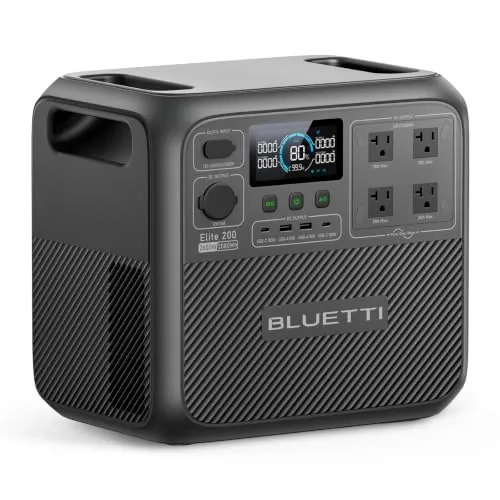
Anker SOLIX C2000 Gen 2 vs BLUETTI Elite 200 V2: Match Power, Panels, and Space
Both are roughly 2 kWh US power stations, but their ratings and carrying shapes differ. BLUETTI’s manual lists 2,600 W total AC output and up to 1,000 W PV input; Anker lists 2,400 W AC and 800 W PV, plus a TT-30R outlet and a compatible BP2000 (Gen 2) expansion path. Anker lists 18.9 kg; BLUETTI’s manual lists 24.2 kg. Match the station to your known load and panel electrical limits, then measure the storage location. These are specifications, not runtime or appliance-start tests.
Read comparison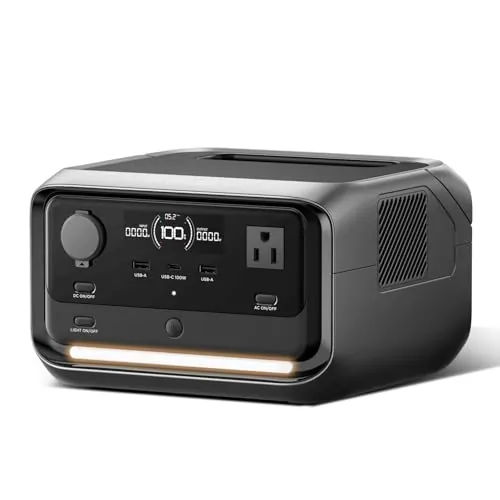
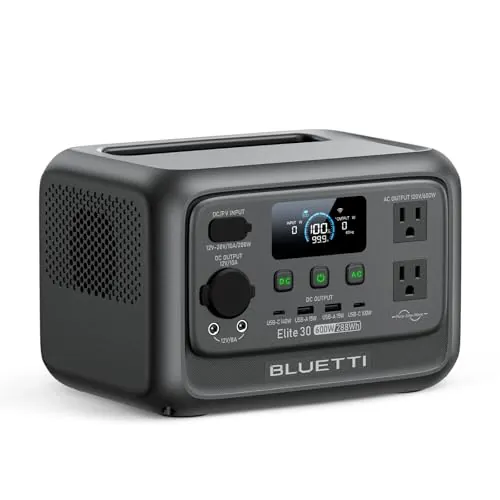
EcoFlow RIVER 3 Plus vs BLUETTI Elite 30 V2: AC Limits, USB-C and Expansion
The exact US RIVER 3 Plus EF-RV-H02-1 lists 286Wh, three 120V AC outlets rated 600W total, and a 100W USB-C output. BLUETTI Elite 30 V2 lists 288Wh, two AC outlets at 120V/600W total, and separate 100W and 140W USB-C outputs. EcoFlow offers an EB300 or EB600 expansion battery separately; BLUETTI says this model does not support battery-pack expansion. Match your equipment's input and startup requirements to the maker's limits before choosing.
Read comparison