
Products compared
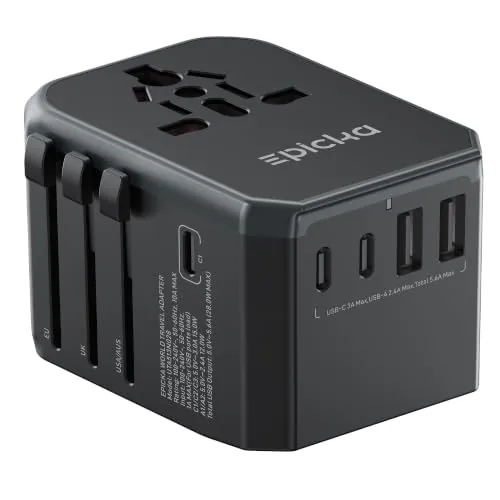
EPICKA
EPICKA Universal Travel Adapter TA-105+
Gray TA-105+ with one AC receptacle, three USB-C ports and two USB-A ports. Check the listing for that port layout and exact model label.
Model TA-105+
Amazon ASIN B078S3M2NX
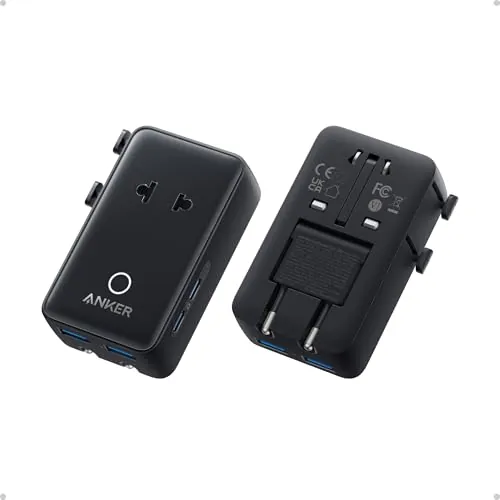
Anker
Anker Nano Travel Adapter A9215
Black A9215 with one AC receptacle, two USB-C ports and two USB-A ports.
Model A9215
Amazon ASIN B0DHVNW1CN
Differences that matter
Sources for Wall pins versus the plug entering the AC receptacle
Sources for AC appliance voltage, grounding and regional rating
Sources for USB port count and shared output
First separate the two plug-fit questions
A travel adapter has a wall side and an appliance side. On the wall side, the adapter's pins must physically match the outlet at the destination. On the appliance side, the device's plug must fit the adapter's AC receptacle. A list for one side does not answer the other.
That distinction matters for this exact pair. EPICKA's TA-105+ manual Appendix B lists appliance plug types accepted by its front receptacle. Appendix A's socket list names the TA-105S, not the TA-105+, so the manual does not establish TA-105+'s destination wall-pin map. Anker lists A/C/G/I as its retractable wall formats and says its front AC receptacle supports Type A or Type C with 4.0 mm round contacts, not Type E/F. Check the actual outlet and each appliance plug before purchase.
Match AC power and grounding to the appliance label
Neither adapter converts voltage. For any appliance connected to an AC receptacle, compare the appliance's stated voltage and grounding requirement with the destination supply and the adapter's exact instructions. Both manufacturers exclude grounded appliance use: EPICKA warns not to use devices requiring a ground wire, while Anker specifies a two-pin adapter whose AC outlet does not take grounded three-prong plugs.
Read the regional and appliance restrictions in the exact manual for the adapter you choose. A physical plug fit does not establish voltage, frequency or grounding compatibility.
Choose the USB layout by what you charge together
If the trip is mainly phones, tablets and other USB-powered gear, compare port count and the manufacturer's output allocation rather than assuming a faster real-world result. The TA-105+ manual lists three 15W USB-C ports, two 12W USB-A ports and 28W total DC output. The A9215 provides two USB-C and two USB-A ports; its USB-C1 is listed up to 20W alone, but Anker caps multiport use at 15W shared.
A quick pre-trip inventory is useful: list each device, the cable connector it uses, whether an AC brick is needed, and how many devices may charge simultaneously. Then compare that list with the output labels and port sharing above. This is a planning check, not a promise about charging time or device compatibility beyond the stated output profile.
Product details
EPICKA Universal Travel Adapter TA-105+
- Accepted device plugs
- The TA-105+ manual Appendix B lists device plug patterns A, B, C, E/F, G, I, J, L, N and O for its AC receptacle. This list does not specify destination wall-socket fit. Source
- USB layout
- Three USB-C ports rated 15W each and two USB-A ports rated 12W each; the manual lists 28W total DC output. Source
- AC limits and warning
- Rated for 100–240 V AC. Does not convert voltage. The manual gives limits for the connected device, wall plug configuration and current draw. Source
Anker Nano Travel Adapter A9215
- Wall plug formats
- Anker lists retractable Type A, C, G and I plugs for the destination outlet. Source
- AC receptacle fit
- The A9215 receptacle accepts Type A and Type C with 4.0 mm round contacts; Anker says Type E and F plugs are not supported. The product is a two-pin adapter and its AC receptacle does not accept three-prong grounded plugs. Source
- USB output allocation
- Four USB ports; Anker rates USB-C1 up to 20W when used alone and multiple-port use at 15W shared maximum. Source
Before you buy
Community discussions
Packing one adapter for several stops
EPICKA Universal Travel Adapter TA-105+
A traveler linked to this EPICKA listing and reported using it for six months while visiting Chile, Argentina, Bolivia and Peru. The reply doesn’t specify which outlets or devices they used.
What to check
Check the outlet types at each stop and the input labels on the devices you plan to bring before choosing an adapter.
Common questions
Does the TA-105+ Appendix A prove that it fits a particular destination wall socket?
No. The exact TA-105+ manual labels Appendix A as compatible sockets but then identifies the adapter in that list as TA-105S. Appendix B is explicitly about non-U.S. device plugs inserted into the TA-105+ AC receptacle. Confirm the TA-105+ wall-pin fit for the actual outlet instead of treating the two lists as interchangeable.EPICKA TA-105+ user manual
Can either travel adapter convert voltage for an appliance?
No. Both manufacturers say these are plug adapters, not voltage converters. Check the appliance nameplate against the destination supply; the adapter does not change the appliance's voltage requirement.EPICKA TA-105+ user manualAnker Nano Travel Adapter A9215 U.S. product page
Which one has more USB ports, and what happens when several are used?
The TA-105+ has three USB-C and two USB-A ports with 28W total DC output stated in its manual. The A9215 has two USB-C and two USB-A ports; Anker lists a 20W USB-C1 solo maximum and 15W shared maximum for multiport use. The ratings do not establish charge time for your device.EPICKA TA-105+ user manualAnker Nano Travel Adapter A9215 U.S. product page
Sources and scope
This is a documentation-based comparison, not electrical testing or a country-by-country compatibility guarantee. EPICKA's exact TA-105+ manual lists accepted device plugs in Appendix B but its Appendix A socket-fit list is explicitly for TA-105S; do not treat it as a TA-105+ wall-pin map. Anker's listed wall formats and outlet-contact fit still do not replace checking the outlet and the device nameplate. Neither product converts voltage, and neither is documented for grounded AC devices. Follow the applicable model, regional and appliance limits together; USB wattage does not predict device charge time.