
Products compared
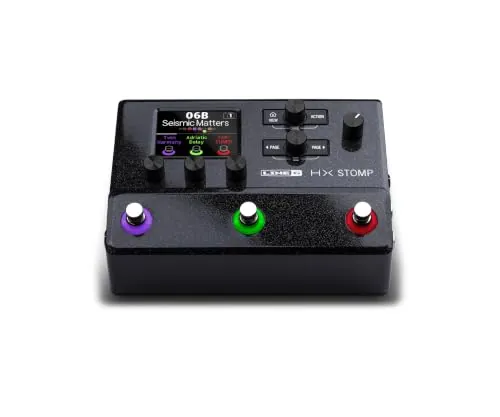
Line 6
Line 6 HX Stomp Multi-Effects Guitar Pedal
The selected U.S. listing is the original HX Stomp, model HX Stomp. This guide does not use HX Stomp XL specifications.
Model HX Stomp
Amazon ASIN B07J2LV1N1
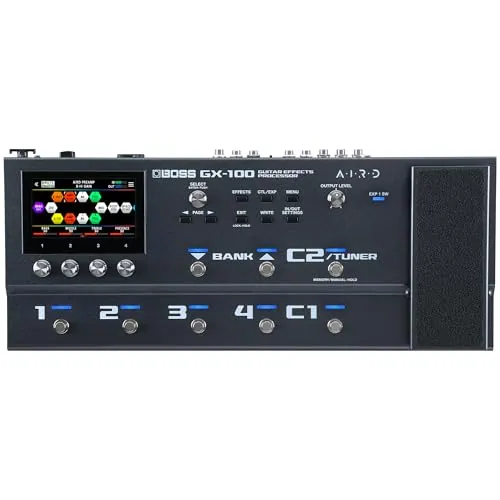
BOSS
BOSS GX-100 Guitar Effects Processor
The selected U.S. listing is the BOSS GX-100 processor; no GX-10, GT-1000CORE or other GX-family specification is substituted.
Model GX-100
Amazon ASIN B09TS62C4H
Differences that matter
What matters most to you?
Choose a priority to see what it changes.
Sources for Footprint and expression-pedal clearance
Sources for Foot control on the unit
Sources for Effects-chain planning
Sources for External effects and amp routing
Sources for USB studio route
Start with the controls you need underfoot
If the processor must sit among a crowded pedalboard, the original HX Stomp is the compact option: Line 6 lists 7 × 5 × 2.5 inches including jacks. It gives you three capacitive footswitches and an EXP/footswitch input that can add controls with the right external pedal or Y cable. The GX-100 takes an 18 1/8 × 7 5/8-inch floor area and includes its expression pedal plus eight assignable footswitch controls. Choose based on the physical controls you need without adding a separate controller, then measure the full cable and pedal envelope.
Those counts describe controls, not how quickly a player can reach them. Make a short list of patch changes, stomp toggles, expression changes and tuner access in your own set, then map them to each unit's documented switch options. If the list needs more than three on-unit switches but you prefer not to mount another controller, GX-100's documented controls may fit that layout; if board space dominates, HX Stomp leaves a much smaller chassis to place.
Plan the effect chain against each unit’s own limits
HX Stomp's 3.80 manual says a preset can use up to eight simultaneous amp, cab, IR, effect or looper blocks, subject to available DSP. BOSS's page lists up to 15 effect blocks and function blocks; its current stated maximum is 15+3 when divider/mixer, send/return and phrase-loop functions are counted, and BOSS says this can depend on circumstances. Because those descriptions count different kinds of elements, the useful pre-buy step is to map your required amps, cabs, third-party IRs, loop, stereo routing and effects into a specific preset on each unit. No tone-quality or processing-performance winner follows from the totals.
Trace your external pedals, amp and computer connections
The send/return layouts differ. HX Stomp's manual describes a stereo TRS send with separate left and right returns and says send/return blocks can be placed in the chain; its setup section also covers the four-cable method. GX-100 has physical SEND and RETURN jacks and a send/return effect block for connecting an external processor; BOSS documents the four-cable method on the product page. If your rig uses stereo pedals or a stereo amp loop, compare the diagrams and cable requirements rather than assuming the sockets are interchangeable.
Both can connect to a computer for audio, but their documented workflows are not identical. HX Stomp's current 3.80 manual describes multichannel USB audio/MIDI, 24-bit/96 kHz, DI recording and re-amping, plus iPad support with an Apple Camera Connection Kit. GX-100's manual documents audio/MIDI exchange, recording from the GX-100 and computer playback through its outputs; it also instructs computer users to install the applicable USB driver. Check current OS/driver/DAW requirements and the route you actually use before including either unit in a studio setup.
Make a floor-space and patch checklist before choosing
Measure the board's open width and depth, allow for side and rear cables, and add GX-100's expression-pedal reach if you want to use the built-in pedal. Then open a representative patch for your set and mark every amp, cab/IR, effect, split, looper and external-loop element you expect to use. HX Stomp's count is up to eight simultaneous blocks subject to DSP; GX-100's count is up to 15 effects and function blocks subject to the different manufacturer caveat. Finally, check whether you need the stereo HX returns or the GX-100's single SEND/RETURN jacks, and confirm the computer driver or mobile adapter against current documentation. These checks make the physical and connection tradeoff visible without assuming either unit will fit or outperform a specific rig.
Product details
Line 6 HX Stomp Multi-Effects Guitar Pedal
- Onboard controls
- Three capacitive footswitches; the EXP 1/2, FS 4/5 jack can support two external footswitches, two expression pedals, or one of each with a Y cable. Source
- Stated footprint
- 7 × 5 × 2.5 in including jacks; check cable exits and neighboring pedals against the actual board. Source
- External loop
- Stereo TRS send plus separate left and right returns; the manual supports positioning send/return blocks in the signal path. Source
- USB recording
- Multi-channel 24-bit/96 kHz USB audio/MIDI interface with DI recording and re-amping; computer/mobile setup requirements depend on host. Source
BOSS GX-100 Guitar Effects Processor
- Onboard controls
- Eight assignable onboard footswitch controls and an integrated expression pedal with toe switch; external footswitch/expression control is also supported. Source
- Stated footprint
- 18 1/8 × 7 5/8 in; height is 2 7/8 in with 3 3/4 in maximum height at the expression pedal. Source
- External loop
- A SEND and RETURN loop can place an external processor in the GX-100 effect chain; check your existing stereo routing because the listed SEND and RETURN are single jacks. Source
- USB recording
- USB carries digital audio and MIDI to/from a computer; the manual says to install the USB driver before connection and the GX-100 can record computer audio or output computer audio through its outputs. Source
Before you buy
Community discussions
Making room for the processor on a smaller board
Line 6 HX Stomp Multi-Effects Guitar Pedal
An HX Stomp owner described moving to a smaller board for a simpler live setup.
What to check
Lay out the processor and the pedals you would keep. Include the room needed for plugs and any switches you want to reach.
Comparing a single processor with keeping your current pedals
BOSS GX-100 Guitar Effects Processor
A player joining a band considered buying the BOSS GX-100 or adding to the pedals they already used.
What to check
List the controls and combinations you want at a rehearsal. Compare how you would reach them with your existing pedals and with the GX-100.
Planning which actions stay available across control modes
BOSS GX-100 Guitar Effects Processor
A GX-100 owner assigned several controls for a live setup and asked how to keep one function available in a particular mode.
What to check
Map the actions you need in each mode before choosing. Check which controls you can assign and what changes when you switch modes.
Common questions
Is HX Stomp the same product as HX Stomp XL?
No. This comparison uses the assigned original HX Stomp model, not the separately named HX Stomp XL. Line 6 keeps a separate product/manual listing for HX Stomp XL, and the dimensions and three-switch layout here are for original HX Stomp.HX Stomp ManualsHX Stomp U.S. product page
Do the listed block counts prove one has more usable effects?
No. HX Stomp lists up to eight simultaneous amp, cab, IR, effect or looper blocks subject to DSP. BOSS lists up to 15 effects/functions, with some additional functional blocks and a qualifier. Since the units count different elements and depend on the selected chain, check the exact preset structure rather than treating the totals as a performance score.HX Stomp 3.80 Owner’s ManualBOSS GX-100 Reference Manual: Main Specifications
Can I connect an external pedal or amp loop?
Both document an external effects route. HX Stomp has a stereo TRS send and separate left/right returns; GX-100 has a single SEND and RETURN jack and documents external-processor/4-cable use. Confirm the exact mono/stereo wiring your rig requires in each manual.HX Stomp 3.80 Owner’s ManualBOSS GX-100 Reference Manual
Which one is ready for computer recording?
Both list USB audio connections, but check the current computer and DAW setup. Line 6 documents a multichannel 24-bit/96 kHz interface with DI/re-amping; BOSS documents recording GX-100 audio and playing computer audio through its outputs, and its reference manual directs users to install its applicable USB driver first.HX Stomp 3.80 Owner’s ManualBOSS GX-100 Reference ManualBOSS GX-100 U.S. support and software page
Sources and scope
Manufacturer manuals establish listed control layouts, connections, block limits and dimensions; they do not establish tonal superiority, live switching speed, latency, reliability or ease of use. HX Stomp block count is DSP-dependent, while GX-100’s effect/function count uses a different definition and also depends on circumstances, so the two counts are not a performance ranking.