
Products compared
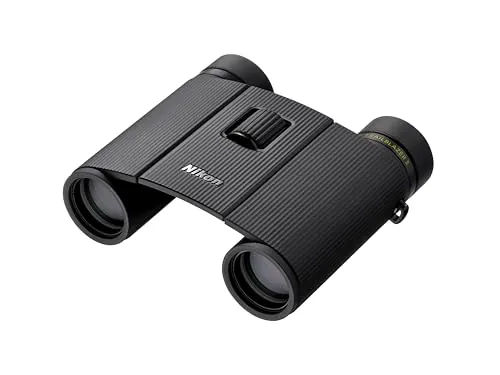
Nikon
Nikon Trailblazer II 8x25 Binoculars
Black 8x25 model, Nikon part/model 16852. This is Trailblazer II, not the original Trailblazer 8x25.
Model 16852
Amazon ASIN B0GP7F6VZ2
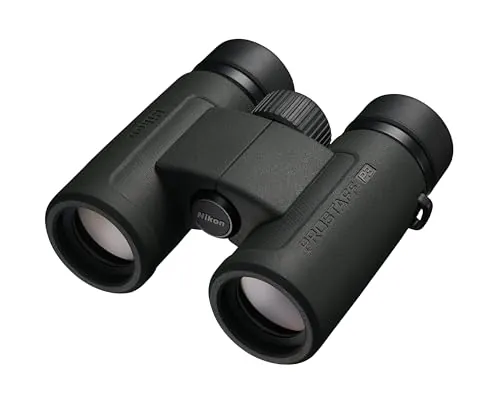
Nikon
Nikon PROSTAFF P3 8x30 Binoculars
Black 8x30 model, Nikon part/model 16774.
Model 16774
Amazon ASIN B0B3JPHPKM
Differences that matter
What matters most to you?
Choose a priority to see what it changes.
Sources for Packed footprint and listed weight
Sources for Field of view at a common distance
Sources for Eye relief and near-focus specification
Start with your pack: Trailblazer II folds narrower
Both are Nikon 8x models, but the Trailblazer II 8x25 is the lower-weight option on paper. Nikon lists model 16852 at 10.9 oz and its Trailblazer II release gives folded dimensions of 3.9 × 2.7 × 2.2 inches. The PROSTAFF P3 8x30 (16774) is listed at 16.75 oz and 4.9 × 5.1 inches length by width. Nikon does not mark that P3 measurement as folded, so compare the published entries carefully and check your pack's actual pocket or compartment.
Trailblazer II is not the original Trailblazer 8x25. Nikon's announcement calls Trailblazer II a new series improving upon the original; the exact U.S. spec page identifies model 16852. Confirm the II name and 16852 in the offer so an older 8217 page is not substituted.
Read the published field numbers at one distance
Nikon lists 145 meters at 1,000 meters for the Trailblazer II and 456 feet at 1,000 yards for the P3. To make the distance basis comparable, 145 m × (914.4 m ÷ 1,000 m) × 3.28084 ft/m = 435 ft at 1,000 yd (rounded). That is a conversion of the published spec, not a test. Nikon also lists real angular fields of 8.3° for Trailblazer II and 8.7° for P3. A wider listed field does not establish sharpness, brightness, or success finding a moving subject.
The listed close-focus distance is 8.2 ft for both models. Objective diameter is 25 mm on Trailblazer II and 30 mm on P3; the guide does not turn either label into a low-light performance conclusion.
Treat eye relief as a try-before-you-buy clue
Nikon lists 10 mm eye relief for Trailblazer II and 15.4 mm for P3. That makes the P3 the longer published figure, but it cannot guarantee that your glasses sit at the right distance or that the full field will be visible to you. If glasses are part of your use, try the exact model while wearing them and position the eyecups as Nikon describes.
Choose based on what matters more in your actual kit: the Trailblazer II's lighter, folded form, or the P3's published field and eye-relief figures. Neither spec sheet establishes subjective comfort or a universally better view.
Pre-buy check: model, bag and viewing setup
Verify Trailblazer II model 16852 rather than the original Trailblazer 8x25, and PROSTAFF P3 8x30 model 16774. Next, compare the listed and folded dimensions against the bag pocket where you will carry them. If the P3's field or eye-relief numbers matter to you, try it with your own glasses and viewing posture before treating the measurements as a fit decision.
No hands-on viewing, stability, brightness, eye-glass-fit or comfort test was performed; the product facts here are the exact Nikon specifications for the two listed models.
Product details
Nikon Trailblazer II 8x25 Binoculars
- Magnification and objective
- 8x magnification; 25 mm objective. Source
- Listed field and eye relief
- 8.3° real angular field; 145 m field at 1,000 m; 10 mm eye relief. Source
- Carry dimensions and weight
- Nikon's Trailblazer II release lists 3.9 × 2.7 × 2.2 in folded (length × width × depth); 10.9 oz. Source
- Close focus
- 8.2 ft. Source
Nikon PROSTAFF P3 8x30 Binoculars
Before you buy
Community discussions
Best affordable binoculars for birding?
Nikon PROSTAFF P3 8x30 Binoculars
A prospective birder comparing the PROSTAFF P3 8x30 with Vortex Raptor 8.5x32 says weight is part of their choice and favors the P3 based on the listings they had seen.
What to check
For a compact-versus-folding carry decision, compare the exact Trailblazer II folded dimensions and P3 body dimensions with your own pack. This buyer was comparing the P3 with a different 8x32 model, not reporting a Trailblazer comparison or a tested carry result.
Common questions
Are these both 8x binoculars?
Yes. Nikon lists 8x magnification for Trailblazer II 8x25 model 16852 and PROSTAFF P3 8x30 model 16774. The comparison is about their other listed specifications, not magnification.Nikon TRAILBLAZER II 8x25 Binoculars — model 16852 specificationsNikon PROSTAFF P3 8x30 Binoculars — model 16774 specifications
How does the field of view compare on the same distance basis?
Nikon lists 145 m at 1,000 m for Trailblazer II, which scales to about 435 ft at 1,000 yd. Nikon directly lists 456 ft at 1,000 yd for the P3. This compares published specifications, not actual image quality.Nikon TRAILBLAZER II 8x25 Binoculars — model 16852 specificationsNikon PROSTAFF P3 8x30 Binoculars — model 16774 specifications
Does the P3's longer eye relief guarantee a better fit with glasses?
No. Nikon lists 15.4 mm for the P3 and 10 mm for Trailblazer II, but personal fit depends on your glasses and viewing position. Try the exact pair if this is a deciding factor.Nikon TRAILBLAZER II 8x25 Binoculars — model 16852 specificationsNikon PROSTAFF P3 8x30 Binoculars — model 16774 specifications
Is Trailblazer II the same product as the original Trailblazer?
No. Nikon describes Trailblazer II as a new series that improves upon the original Trailblazer and lists a separate Trailblazer II 8x25 model, 16852. Confirm the II name and 16852 model on the offer.Nikon Introduces the Ultra Compact Trailblazer II BinocularNikon TRAILBLAZER II 8x25 Binoculars — model 16852 specifications
Sources and scope
This is a manufacturer-spec comparison, not a viewing, brightness, steadiness, carry-comfort or eyeglass-fit test. The Trailblazer II figures are for Nikon's 16852 second-generation model, not the original Trailblazer. The Trailblazer's 1,000-yard field width below is calculated from Nikon's 145 m at 1,000 m; the P3's 456 ft figure is directly listed by Nikon. Eye relief does not guarantee fit for a particular person's glasses or eye position.
Related comparisons
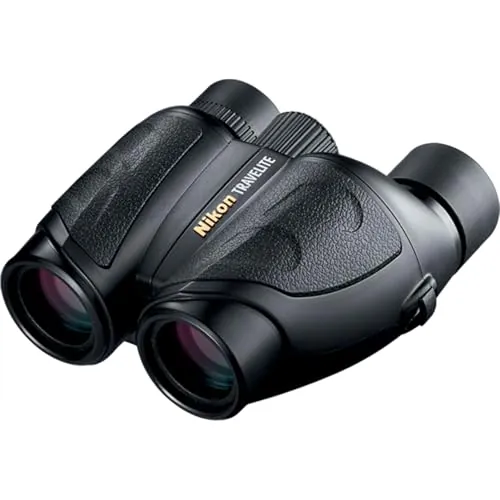
Nikon Trailblazer II 8x25 vs Travelite 8x25: Field, Eye Relief and Close Focus
Both are black Nikon 8x25 binoculars, but the Trailblazer II (16852) lists an 8.3° real field of view and 8.2 ft close focus, while Travelite 7277 lists 5.6° and 9.8 ft. Travelite lists 14 mm eye relief and 9.3 oz weight; Trailblazer II lists 10 mm and 10.9 oz. These specifications help narrow your priorities, not predict image quality or eyeglass comfort.
Read comparison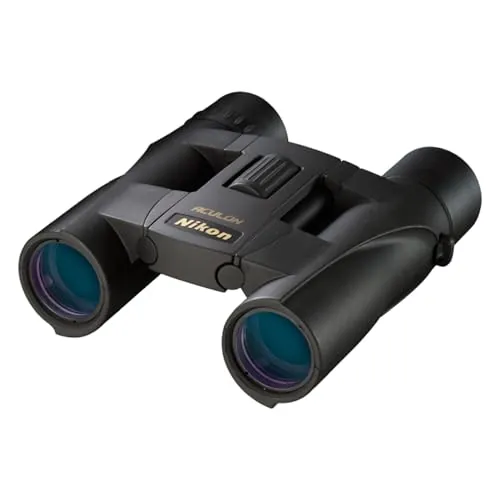
Nikon Trailblazer II 8x25 (16852) vs ACULON A30 10x25 Black (8263)
Nikon lists the Trailblazer II 16852 at 8x with an 8.3° real field of view; the black ACULON A30 8263 is 10x with a 5° real field. Both are listed with an 8.2 ft close-focus distance. ACULON is 0.6 mm longer in listed eye relief and 1.2 oz lighter, but Nikon provides a three-number body size only for the Trailblazer II. These specifications help shortlist; they do not prove image quality, steadiness, eyeglass fit or case fit.
Read comparison