
Products compared
NITECORE
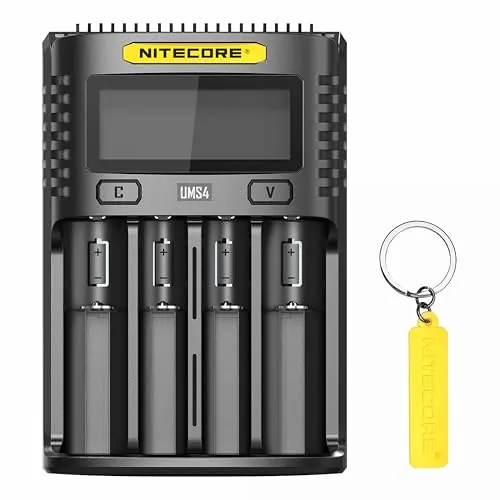
NITECORE UMS4 Four-Slot Charger
Four independently controlled charging slots; exact listed model UMS4. The manufacturer lists a USB charging cable; verify the exact retail offer for its power adapter.
Model UMS4
Amazon ASIN B07TX4TYYB
XTAR
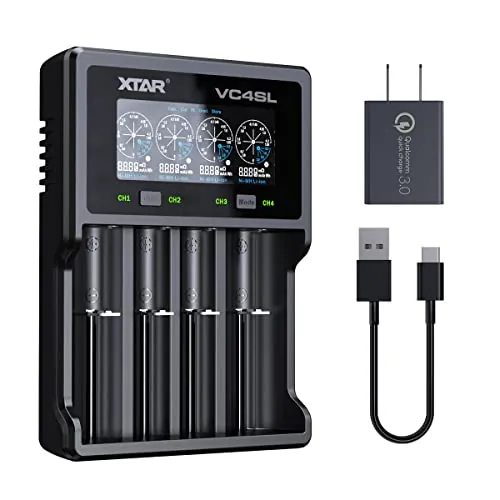
XTAR VC4SL USB-C 4-Bay LCD Smart Battery Charger and Analyzer
Four-bay USB-C charger; XTAR lists 3.6/3.7V Li-ion and 1.2V Ni-MH cells and explicitly notes protected 21700 compatibility. Check the exact retailer kit for adapter inclusion.
Model VC4SL
Amazon ASIN B0GSVC71B7
Differences that matter
What matters most to you?
Choose a priority to see what it changes.
Sources for Positive cell chemistry and format listings
Sources for Automatic detection and special chemistry settings
Sources for USB input and adapter planning
Sources for Documented screen and test/storage workflow
Start with the battery label, not a charger headline
NITECORE publishes a longer compatibility list for UMS4: IMR, Li-ion and LiFePO4 cells in named cylindrical formats including 10440, 14500, 16340, 18650, 21700 and 26700, plus Ni-MH/Ni-Cd AA, AAA, AAAA, C and D. XTAR's VC4SL page positively lists 3.6/3.7V Li-ion and 1.2V Ni-MH and specifically calls out protected 21700 cells. These descriptions help you find a documented match; they do not prove that an omitted chemistry or size is unsupported by the other model.
For a buyer with protected 21700 cells, XTAR's positive model-specific wording is useful. If your batteries are another shape or chemistry, check the complete current compatibility information for that exact charger, including the cell's protected/unprotected construction and length. Do not assume two cells with similar names are interchangeable.
UMS4 has a manual-setting exception that matters
NITECORE says UMS4's automatic voltage detection covers standard 3.6/3.7V Li-ion and Ni-MH/Ni-Cd, while LiFePO4 and 3.8V Li-ion are excluded from automatic selection. Its manual says those two types require manual cutoff-voltage settings. If either label appears on your cell, use the current UMS4 manual exactly; this comparison does not replace the manual with step-by-step charging instructions.
The practical question is whether you can positively identify the cell and follow the maker's specific settings. If not, pause and ask the battery or charger maker. Do not infer a safe setting from a different voltage label, another charger, or the cells' appearance.
Compare the documented charging and storage routine
Both products are four-slot chargers with current controls and displays. The UMS4 manual describes four independently controlled slots, manual charging-current selection and LCD status/internal-resistance information. XTAR lists selectable current from 0.25A to 3A, Grade Mode, Storage Mode and internal-resistance measurement for VC4SL.
If the named Grade or Storage workflow is a requirement, VC4SL is the model whose page explicitly lists it. That does not prove that UMS4 lacks an unlisted capability, and it does not prove the VC4SL test is more accurate. Neither charger is ranked here by charging speed, capacity accuracy, battery health, or life.
Check the adapter protocol and the exact box contents
For UMS4, NITECORE specifies DC 5V/2A or 12V/1.5A, with 18W maximum, and says QC 2.0 input is available. Its package list names a USB charging cable. For VC4SL, XTAR identifies QC3.0 at 9V/2A and recommends a compatible PD adapter of 20W or higher for its USB-C models such as VC4SL. Follow the charger maker's input requirements and compare them with the output and protocol printed on the adapter.
The USB-C connector alone does not tell you whether a power brick supports the protocol used for the charger’s fast-input mode. Also, an official model page is not proof that every seller bundle includes a wall adapter. Review the selected retailer package details and buy only the adapter required by the manufacturer.
Leave damaged-cell recovery to the manufacturer
NITECORE's manual warns not to charge cells that are damaged, leaking, swollen, or have a damaged wrapper or case. UMS4's page describes some activation/restoration features, but this guide intentionally gives no recovery instructions. If a cell is damaged or reports an error, stop using it and follow the cell maker's disposal/support guidance rather than trying a charger mode based on a comparison article.
For routine charging, use only rechargeable chemistries the exact charger lists, check polarity and the correct cell mode, and stay within the maker's current manual. These are model-specific operating boundaries, not a claim that either charger is safer than the other.
Product details
NITECORE UMS4 Four-Slot Charger
- Manufacturer-listed chemistries and cell sizes
- IMR/Li-ion/LiFePO4: named cylindrical formats include 10440, 14500, 16340, 18650, 21700 and 26700; Ni-MH/Ni-Cd: AA, AAA, AAAA, C and D Source
- Special chemistry handling
- LiFePO4 and 3.8V Li-ion are excluded from automatic voltage detection and require manual cutoff-voltage settings per the UMS4 manual Source
- USB input
- DC 5V/2A or 12V/1.5A; 18W maximum; QC 2.0 input available Source
- Charging workflow
- Four independent slots; manual current selection; LCD shows charging information and internal resistance/battery-health indication Source
XTAR VC4SL USB-C 4-Bay LCD Smart Battery Charger and Analyzer
- Manufacturer-listed cell chemistry and special format
- 3.6/3.7V Li-ion and 1.2V Ni-MH; protected 21700 batteries explicitly named Source
- USB input recommendation
- XTAR identifies QC3.0 at 9V/2A for VC4SL; the maker recommends a compatible PD adapter of 20W or higher for USB-C models such as VC4SL Source
- Charging workflow
- Selectable current from 0.25A to 3A, Grade Mode capacity test, Storage Mode and internal-resistance measurement Source
Before you buy
Community discussions
Checking the full name when several chargers look similar
NITECORE UMS4 Four-Slot Charger
A shopper looking for a first multi-bay charger considered the Nitecore UMS4 and several XTAR models and wanted help telling the versions apart.
What to check
Read the complete code on the listing and carton. Compare the listed cell sizes, bay spacing and display labels on the manufacturer’s documentation.
Common questions
Which charger explicitly supports protected 21700 cells?
XTAR explicitly names protected 21700 compatibility for the VC4SL. NITECORE lists the 21700 format for UMS4 but does not specify protected status on the cited product page. Confirm your exact cell type against the manual before charging.VC4SL ChargerProduct Comparison for XTAR VC4, VC4S, VC4L, VC4H, VC4SLUMS4 Intelligent USB-C Four-Slot Superb Charger
Can UMS4 automatically select the right setting for LiFePO4 or 3.8V Li-ion?
No. NITECORE states those chemistries are excluded from automatic voltage detection, and its UMS4 manual calls for manual cutoff-voltage settings. Identify the exact cell and follow the manual; do not guess or borrow a setting from another chemistry.UMS4 Intelligent USB-C Four-Slot Superb ChargerUMS4 User Manual
What USB power source should I plan for?
UMS4 specifies DC 5V/2A or 12V/1.5A, up to 18W, and has QC 2.0 input. XTAR identifies QC3.0 at 9V/2A for VC4SL and recommends a compatible PD adapter of 20W or higher for its USB-C models such as VC4SL. Read the adapter label and current maker guidance; USB-C connector shape alone does not confirm the required charging profile.UMS4 Intelligent USB-C Four-Slot Superb ChargerXTAR Adapter Guide: Why the Right Power Adapter Matters
Do the product pages prove an included wall adapter?
No. The UMS4 package list names a USB charging cable, and the XTAR VC4SL page describes USB-C input without confirming every retailer bundle. Check the exact seller offer for the adapter and cable before ordering.UMS4 Intelligent USB-C Four-Slot Superb ChargerVC4SL Charger
Does Grade Mode prove the VC4SL measures capacity more accurately?
No matched measurement test is used here. XTAR describes a Grade Mode capacity test, while NITECORE documents charging-status readings and internal-resistance display. Those feature descriptions do not establish comparative accuracy or battery health.VC4SL ChargerUMS4 User Manual
Sources and scope
Follow the current manufacturer instructions for the exact charger and supported rechargeable cell. NITECORE's current model page describes a USB-C version; the reviewed documents do not establish the port on every retailer unit. Check the seller's package for the included cable and adapter.
Related comparisons
Milwaukee 48-59-1808 vs 48-59-1806: M12 Flexibility or an M18 Queue?
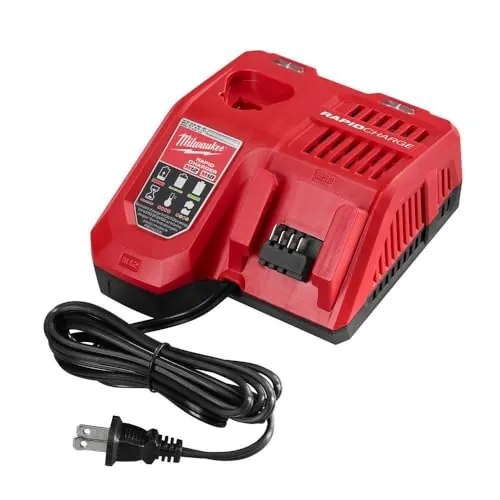
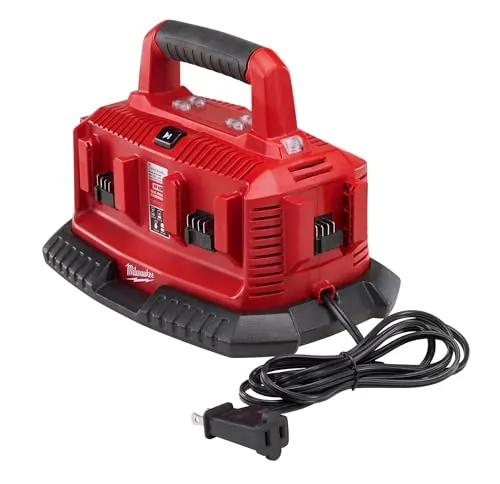
Both chargers take turns charging packs. The 48-59-1808 supports Milwaukee M12 and M18 and queues a second inserted pack after the first is full. The 48-59-1806 is M18-only, with six sequential positions and a skip button. Its official product page also lists hang holes and a pass-through plug. Check your battery family first, then decide whether you need a larger M18 queue or a mounting and outlet arrangement that fits your workspace. The 48-59-1808NNO listing is labeled opened or non-retail packaging, so verify its exact condition and seller terms before checkout.
Read comparison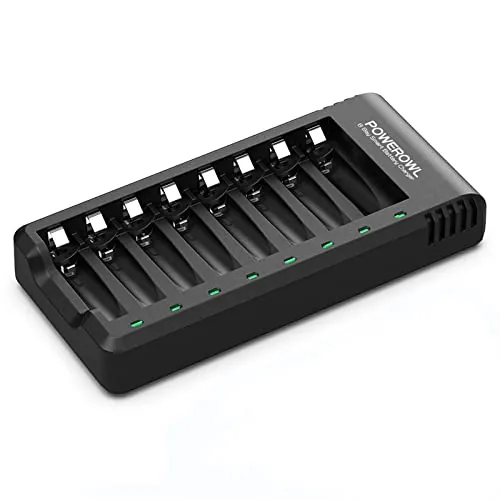
POWEROWL ZN825E vs EBL C708S3L: Chemistry and USB Input
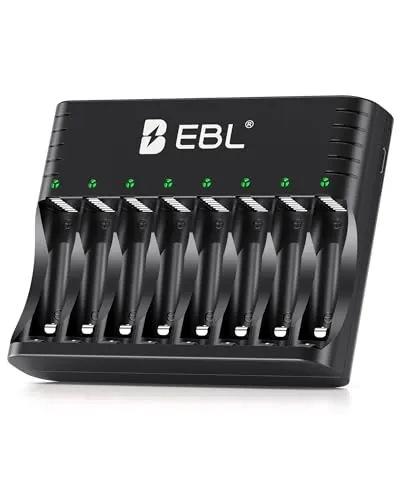
POWEROWL's ZN825E manual limits the charger to 1.2V NiMH/NiCd AA/AAA cells and documents a Micro-USB cable in the box. EBL lists C708S3L support for those cells plus 1.5V Li-ion AA/AAA, with independently managed slots and USB-C input. Both list 5V/2A input; confirm the EBL offer's cable contents and do not infer a speed difference from the connector.
Read comparison