
Products compared
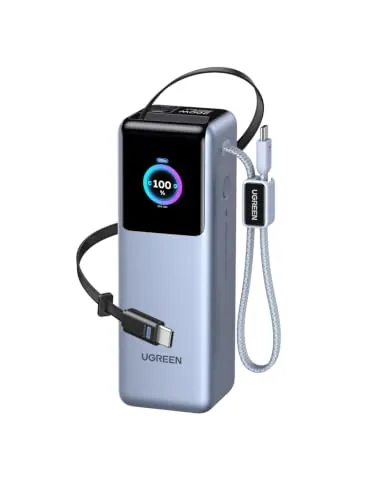
UGREEN
UGREEN Nexode Pro Power Bank
US listing; PB728 model and 75702 SKU match the assigned configuration. The manufacturer's US page contains conflicting capacity text, which is not used here.
Model PB728 (US listing SKU 75702)
Amazon ASIN B0GS97HMFN
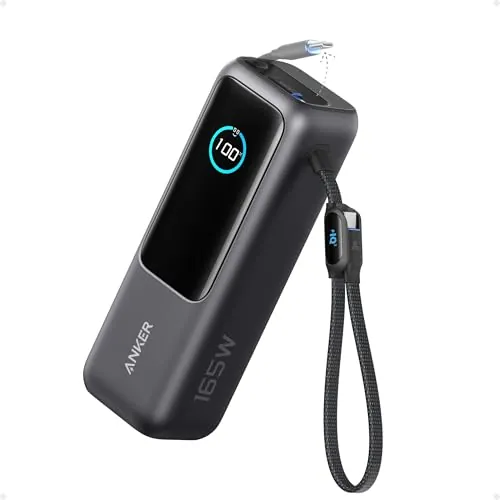
Anker
Anker Laptop Power Bank (25K, 165W, Built-In and Retractable Cables)
Black US listing data configuration; three USB-C outputs and one USB-A output, including two integrated USB-C cables.
Model A1695
Amazon ASIN B0DCBB2YTR
Differences that matter
What matters most to you?
Choose a priority to see what it changes.
Separate a single-port rating from the bank's total
A 100W USB-C figure describes an individual port's maximum under the maker's stated conditions. It does not mean that every port can provide that amount simultaneously. Both makers list up to 100W on their USB-C outputs, so the key question becomes how their banks share power when you connect more than one device.
The PB728 US page says three USB-C outputs are each rated up to 100W and the total output can reach 200W. The same page says four devices can be connected at once, but it does not show a complete allocation chart for specific port combinations. The UGREEN capacity field also conflicts with the title and product copy, so this guide leaves capacity out of the comparison.
Anker publishes more of the port map
For the A1695, Anker's product and support pages specify the combined ceilings: any two USB-C ports share up to 165W; a USB-C and USB-A pair are listed up to 100W and 33W; and three or four outputs can reach up to 130W. In the latter cases, Anker specifies 100W on one designated USB-C port while the remaining ports share 30W.
The support page attaches a condition to those values: they are available when battery level reaches 78%, and output is lower below that threshold. Treat the table as a way to screen whether your port plan fits, not as a guarantee of your device's charging speed.
A practical pre-buy port check
List the devices you expect to charge together, each device's accepted input, the cable you will connect, and which output will be occupied. Start with the device that needs the most power, then add the other devices and compare that exact port combination with the manufacturer's table.
This check gives the A1695 a concrete advantage when its documented USB-A or multi-port split matches your device list. The PB728 may fit a higher combined USB-C requirement, but ask UGREEN for the exact allocation if your decision depends on a particular pair exceeding Anker's published 165W two-USB-C maximum. Neither headline total alone settles negotiated device output.
Product details
UGREEN Nexode Pro Power Bank
The PB728 is a candidate when your setup may use its advertised 200W combined ceiling, but the cited US page does not tell a buyer how that ceiling is divided across each exact port combination. Verify the required combination before treating 200W as available to your devices together.
- USB-C ports and single-port ceiling
- The US page lists three USB-C outputs, each up to 100W. Source
- Combined output
- Up to 200W total; the US page does not give a full per-combination allocation table. Source
- USB-A ceiling in the US product-page specification
- Not specified clearly on the cited US page; confirm the exact USB-A output and the port combination with UGREEN if your device depends on it. Source
Anker Laptop Power Bank (25K, 165W, Built-In and Retractable Cables)
A1695 is the easier model to evaluate when you need a published port-by-port allocation. Anker's support page says its listed maxima are available at 78% battery or higher and that output is reduced below that level; these are not unconditional charging-speed promises.
- Single-port output
- Each USB-C output up to 100W; USB-A up to 33W. Source
- Two-port output
- Any two USB-C ports share up to 165W total; USB-C plus USB-A is listed up to 100W plus 33W. Source
- Three- and four-port output
- Up to 130W total: a designated USB-C port can receive 100W while the remaining listed ports share 30W, subject to the support page's stated battery-level condition. Source
Before you buy
Community discussions
A Zephyrus G16 owner describes using an A1695 bank
Anker Laptop Power Bank (25K, 165W, Built-In and Retractable Cables)
A Zephyrus G16 owner described using an Anker A1695 away from wall power for light laptop work and video.
What to check
Identify what your laptop needs for the work you do away from an outlet. Check the bank’s documented port combinations if you also want to charge a phone or another device.
Common questions
Does the UGREEN PB728 provide 200W to any two devices?
The US product page advertises up to 200W total and three USB-C outputs up to 100W each, but it does not provide a complete two-port allocation chart. Do not assume a particular pair can split the total as needed; confirm that exact combination with UGREEN.UGREEN 200W Power Bank 25000mAh Fast Charging Built-in Cable (US product page; SKU 75702)
Can the Anker A1695 give every connected port its single-port maximum at once?
No. Anker's support table caps total output by the ports used: for example, two USB-C ports share up to 165W, while its listed three- and four-port cases allocate 100W to a designated USB-C port and share 30W across the remaining ports. Anker says the stated figures require at least 78% battery and that output is reduced below that level.How Power Is Distributed in Anker Power Bank (25K, 165W, Built-In and Retractable Cables)
Does the higher advertised wattage mean the PB728 charges every device faster?
No. These are output limits, not measured charging times. The connected device must accept a compatible charging profile, and cable, port selection and simultaneous load all affect the negotiated output.UGREEN 200W Power Bank 25000mAh Fast Charging Built-in Cable (US product page; SKU 75702)Anker Laptop Power Bank (25K, 165W, Built-In and Retractable Cables; Model A1695)
Sources and scope
This is a specification comparison, not a charging-speed or sustained-output test. Maximum output is not the same as a device's actual charging rate: device input, cable and negotiated charging profile matter. UGREEN's US page gives a 20,000mAh value in its structured specification while its title and product copy state 25,000mAh; capacity is excluded from the recommendation pending clarification. UGREEN's US page does not publish a clear combination-by-combination output table. This guide also does not determine whether either bank is permitted on a particular flight; check current airline and regulator rules for your trip.
Related comparisons
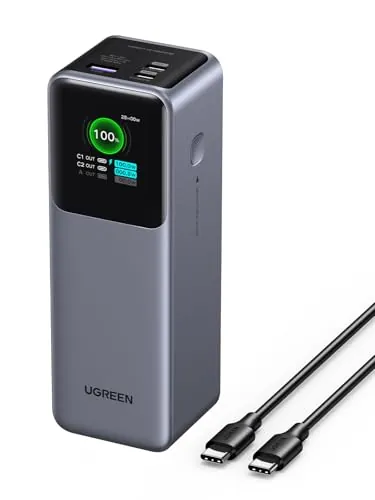
Anker A1695 vs UGREEN 35525
Anker A1695 offers up to 100W from one USB-C connection and up to 165W total with two USB-C devices; Anker says the maximum falls to 130W when three or four devices charge. UGREEN 35525 lists up to 140W from USB-C1 and up to 100W from USB-C2, with a 200W total-output label. Treat these as different port and shared-output limits, not a single-port 165W versus 200W contest. Both makers list 25,000mAh/90Wh, but device protocol, cable, battery state and simultaneous loads still affect what your devices receive.
Read comparison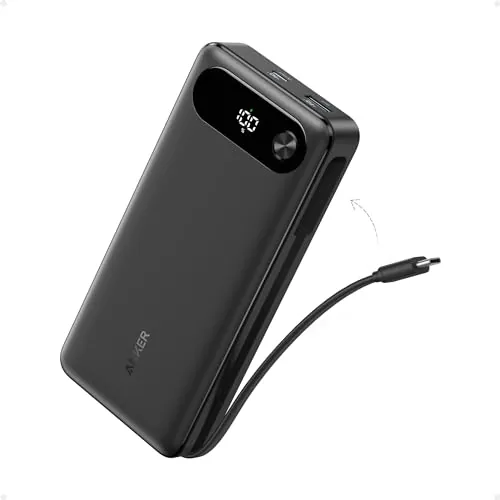
Anker A1695 vs A1383: More Shared Laptop Power or a Thinner Carry?
These assigned black single power banks answer a travel-kit choice: Anker A1695 (ASIN B0DCBB2YTR) offers 25,000mAh and publishes up to 165W across two USB-C outputs, plus up to 130W total with three or four devices connected. Anker A1383 (ASIN B0CXDXP8VR) has a 20,000mAh rating and lists up to 65W from one USB-C cable or port plus 22W from USB-A, 87W total. A1695 includes a retractable USB-C cable and a shorter cable that doubles as a lanyard; A1383 has one built-in USB-C cable. A1695 is listed at 595g and 49mm thick; A1383 at 430.91g and 26mm thick. Choose by your devices' USB-C input profiles and intended simultaneous connection pattern, then compare the listed shape and weight with your carry setup. These are manufacturer specifications, not tested charging speeds or guaranteed device runtimes.
Read comparison