
Products compared
Nikon
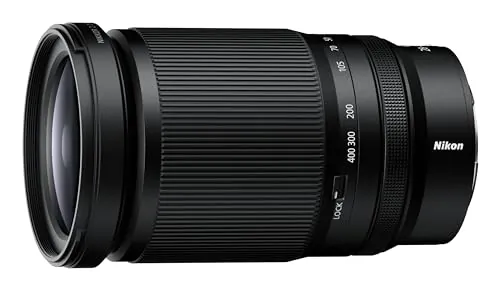
NIKKOR Z 28-400mm f/4-8 VR
Nikon USA model 20125; FX-format Nikon Z-mount 28–400 mm variable-aperture zoom.
Model 20125
Amazon ASIN B0CZ4JX9JW
Nikon
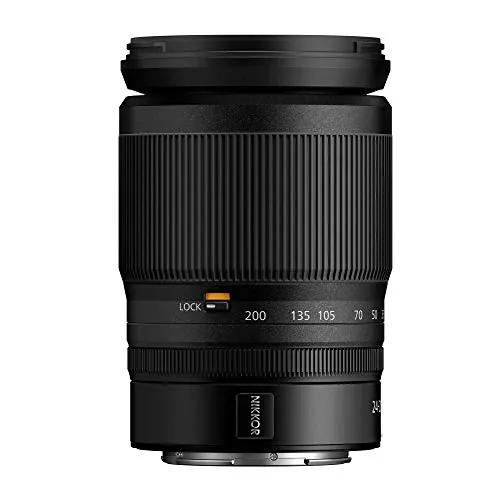
NIKKOR Z 24-200mm f/4-6.3 VR
Nikon USA model 20092; FX-format Nikon Z-mount 24–200 mm variable-aperture zoom.
Model 20092
Amazon ASIN B084QP747Q
Differences that matter
Sources for Framing range by sensor format
Sources for Variable maximum aperture
Sources for Minimum focus and close-up figures
Sources for Lens-only carry and filter setup
Map your usual framing to each zoom range
The 24–200mm covers 24 mm at the wide end through 200 mm at telephoto. The 28–400mm starts at 28 mm and reaches 400 mm. Nikon’s published FX angle ranges are 84°–12°20′ and 75°–6°10′ respectively; on DX the listed ranges are 61°–8° for the 24–200mm and 53°–4° for the 28–400mm. At either format, the 24–200mm begins wider and the 28–400mm reaches farther. This follows from the manufacturer’s specifications; no sample-image comparison was made.
If your common subjects require both a wider-than-28mm view and framing beyond 200mm, neither lens covers both endpoints alone. You would need to accept a lens change or compare a different range.
Treat aperture and close-focus figures as zoom-specific
Nikon lists a variable maximum-aperture range of f/4–8 for the 28–400mm and f/4–6.3 for the 24–200mm. Both start at f/4, but the telephoto endpoints occur at different focal lengths (400 mm versus 200 mm). The ranges alone cannot tell you the maximum aperture at every intermediate focal length or prove a low-light advantage at the same framing.
Minimum focus distance also changes with zoom: 28–400mm is 0.2 m at 28 mm and 1.2 m at 400 mm; 24–200mm is 0.5 m at 24 mm and 0.7 m at 200 mm. Nikon measures from the focal plane, so these numbers are not distance from the lens front. The listed maximum reproduction ratios (0.35× at 28 mm for the 28–400mm and 0.28× for the 24–200mm) describe each lens’s published maximum. Nikon’s 24–200mm global specification does not give a focal position for its figure.
Check filter and camera-bag fit
The 28–400mm is listed at 725 g and 77 mm filter attachment; the 24–200mm at 570 g and 67 mm. The 155 g difference is lens-only arithmetic, not the difference between fully packed camera kits. Check the diameter engraved on your existing filter and confirm any separate step ring or hood arrangement before assuming reuse.
Nikon gives approximate lens dimensions as diameter × length from the camera mount flange to the lens end: 84.5 × 141.5 mm for the 28–400mm and 76.5 × 114 mm for the 24–200mm. These manufacturer dimensions are a planning reference, not a measurement of your camera-and-lens bag space or the extended length while zooming.
Product details
NIKKOR Z 28-400mm f/4-8 VR
This FX Z-mount zoom covers 28–400 mm. Nikon lists its maximum aperture as f/4–8, with minimum focus distance changing from 0.2 m at 28 mm to 1.2 m at 400 mm. Its published lens-only weight is 725 g and it takes 77 mm filters.
- Focal range and maximum aperture
- 28–400 mm; maximum-aperture range f/4–8 Source
- Minimum focus distance
- 0.2 m at 28 mm; 1.2 m at 400 mm, measured from the focal plane Source
- Maximum reproduction ratio
- 0.35× at 28 mm Source
- Lens-only carry and filter fit
- Approx. 84.5 × 141.5 mm from mount flange to lens end; 725 g; 77 mm filter attachment Source
NIKKOR Z 24-200mm f/4-6.3 VR
This FX Z-mount zoom starts wider at 24 mm and reaches 200 mm. Nikon lists its maximum aperture as f/4–6.3 and its minimum focus distance as 0.5 m at 24 mm or 0.7 m at 200 mm. Its listed weight is 570 g and filter size is 67 mm.
- Focal range and maximum aperture
- 24–200 mm; maximum-aperture range f/4–6.3 Source
- Minimum focus distance
- 0.5 m at 24 mm; 0.7 m at 200 mm, measured from the focal plane Source
- Maximum reproduction ratio
- 0.28× Source
- Lens-only carry and filter fit
- Approx. 76.5 × 114 mm from mount flange to lens end; 570 g; 67 mm filter attachment Source
Before you buy
Community discussions
24–200 or 28–400 for a travel setup?
NIKKOR Z 24-200mm f/4-6.3 VR
A prospective Z5 II buyer weighing the 24–200 against the 28–400 says they want to avoid returning to a large carry kit and occasionally photograph aircraft.
What to check
For travel, decide whether the 24mm wide end or 400mm reach better fits your itinerary, then check each lens’s dimensions and weight against the bag you plan to carry. This is one buyer’s choice context, not an optical-performance verdict.
Common questions
Which lens starts wider?
Nikon lists 24 mm at the wide end of the NIKKOR Z 24-200mm f/4-6.3 VR and 28 mm for the NIKKOR Z 28-400mm f/4-8 VR. Their published angle-of-view ranges also show the 24–200mm starting wider on both FX and DX formats.Nikon Consumer NIKKOR Z 28-400mm f/4-8 VR specificationsNikon Consumer NIKKOR Z 24-200mm f/4-6.3 VR specifications
Does the 28-400mm focus as close at 400mm as it does at 28mm?
No. Nikon lists its minimum focus distance as 0.2 m from the focal plane at 28 mm and 1.2 m at 400 mm. The 24–200mm is listed at 0.5 m at 24 mm and 0.7 m at 200 mm. These are zoom-position-specific distances, not measurements from the front of the lens.Nikon Consumer NIKKOR Z 28-400mm f/4-8 VR specificationsNikon Consumer NIKKOR Z 24-200mm f/4-6.3 VR specifications
Can I use one 77 mm filter directly on both?
No, not directly on the native filter threads: Nikon lists 77 mm for the 28–400mm and 67 mm for the 24–200mm. A different diameter requires a separate, compatible step ring if that setup works with the filter and hood you plan to use.Nikon Consumer NIKKOR Z 28-400mm f/4-8 VR specificationsNikon Consumer NIKKOR Z 24-200mm f/4-6.3 VR specifications
Is f/8 the aperture of the 28-400mm at every zoom setting?
No. Nikon lists a variable maximum-aperture range of f/4–8 for the 28–400mm and f/4–6.3 for the 24–200mm. The maximum aperture changes across each zoom range, so comparing the printed range endpoints does not establish performance at a shared focal length.Nikon Consumer NIKKOR Z 28-400mm f/4-8 VR specificationsNikon Consumer NIKKOR Z 24-200mm f/4-6.3 VR specifications
Sources and scope
This guide organizes Nikon’s exact-model published specifications. It is not an image-quality, autofocus, stabilization, handling or field-of-view test. Minimum focus distances are measured from the focal plane, vary by zoom position and are not working distances measured from the lens front.
Related comparisons
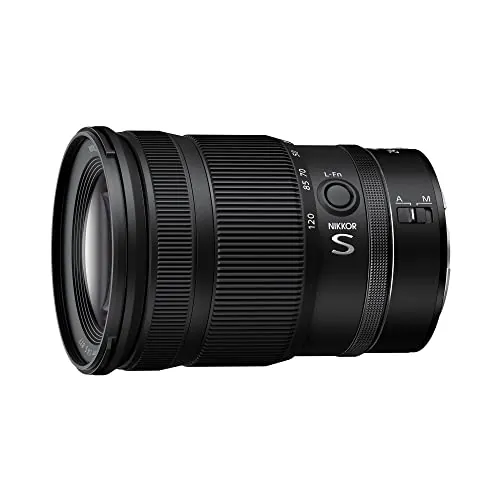
NIKKOR Z 24-120mm f/4 S vs 24-200mm f/4-6.3 VR: Constant Aperture or More Reach?
Both Nikon Z zooms start at 24mm and work on FX and DX bodies. The NIKKOR Z 24-120mm f/4 S keeps a maximum f/4 aperture across its 24–120mm range; the 24-200mm f/4-6.3 VR reaches 200mm, with a maximum aperture that varies to f/6.3 and an in-lens VR rating. The 24-200mm is listed at 570g with a 67mm filter thread, versus 630g and 77mm for the 24-120mm. Choose by your usual framing, stabilization setup, and filter/carry kit—not a claimed optical test result.
Read comparison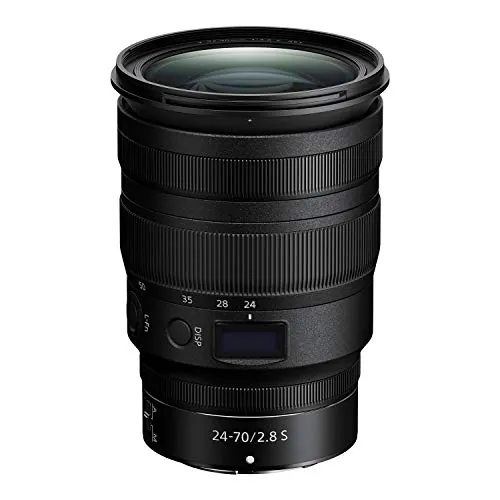
NIKKOR Z 24-70mm f/2.8 S vs Z 24-200mm f/4-6.3 VR: Range, Stabilization and Carry
The original NIKKOR Z 24-70mm f/2.8 S (model 20089) keeps a constant f/2.8 maximum aperture across 24–70mm and relies on compatible Z camera in-body VR for its listed five-axis stabilization behavior. The NIKKOR Z 24-200mm f/4-6.3 VR (model 20092) reaches 200mm, has lens VR, and takes smaller 67mm screw-in filters instead of 82mm. Nikon lists these lenses at 805g and 570g; screen your focal needs, camera body's stabilization, existing filters and packed size before choosing.
Read comparison